Showing posts with label handicapped. Show all posts

Wednesday, September 14, 2022

Beach wheelchairs are everywhere. Who knew?


I went to the beach this summer. I relaxed in the sand, just feet away from the water, watching children and adults and dogs having a wonderful time walking, playing, digging, relaxing, wading and swimming.

Occasionally, I would close my eyes, take a deep breath and drink in the soothing sounds of the waves.

That might not seem like a big deal to many, but it was to me. I’ve lived in Southern California for nearly 20 years and I hadn’t been that close to the surf since 2014.


Because I am disabled and have depended on a walker since 2005, sand is not my friend. “A day at the beach” does not connote ease or relaxation. For me, that phrase signifies frustration and a bit of mourning for what I am no longer able to do.

But this summer, I discovered beach wheelchairs.

Hallelujah!

With an asterisk.

Yay to their availability and affordability.

Boo to the fact that their existence is news to many, including the people who can use them and some staff at the beaches. And another boo to the cumbersome borrowing process and difficulty of getting into an accessible restroom from the monster truck version of a wheelchair.

A California girl, I cherished the proximity of the ocean and have many fond memories of days at the beach in northern, central and southern parts of the coast.

When I became disabled after my horrifying battle with cancer, I realized my limitations and resigned myself to enjoying the view from a car or sitting on a bench near the sand.

I learned on Facebook about Sabrina Cohen, a woman in Miami Beach who was working to make beaches accessible for the mobility-impaired. I commented, “We could use you in California.”

In 2014, I had my last close-to-the-surf excursion. I was determined to explore the possibilities of using my walker at the beach. My husband, who has helped steer me through non-Hodgkins lymphoma, a stem cell transplant and disability, packed in the car two of my walkers, foldable beach chairs and a blanket. When we got to Zuma Beach in Malibu, he guided me as I trekked unsteadily through the sand, lifting my walker step-by-step. I worried sand would somehow ruin my mobility aid. When I got to a midpoint in the sand, I transferred to a beach chair for a few minutes and then lay down flat on the blanket blissfully.


I don’t remember how I got up, but my husband must have put forth a Herculean effort. In the ensuing years, my muscles have weakened so that I often need assistance just getting up from a regular chair (from two people if possible). So I’ve scratched lying in the sand from my to-do list.

I did make a mental note when I saw an article somewhere that said a beach in Ventura had accessible wheelchairs available. I never investigated it further until this summer after learning relatives and their grandchildren were planning as visit and they wanted to go to a beach. A quick computer search led me to the San Buenaventura State Beach website which explained how to reserve a wheelchair free of charge over the phone.

We planned a trial run on a weekday when crowds would be minimal. The day before our excursion, I called the number listed on the site and left a message. When no one called back, I phoned  later in the day. This time a lifeguard answered, said he couldn’t reserve one for me and I should call back the following morning. I called again the next day and again no one answered. I left a message saying we were on our way there (a 40 minute drive) and hopefully we would be able to borrow the chair.

We arrived there without knowing who to contact. While I waited in the car, my husband walked to a few administrative buildings before finding someone to help us. After a few more missteps, we got a larger-than-life beach wheelchair, which was one of four in a storage container, under lock and key.

I was able to sit in it fairly easily and my husband placed my portable fold-up walker on the rack below. Then he had to push me through the parking lot and paved trails to the boardwalk where we reached the sand - and about a 10-inch drop off. I was nervous about being tilted back in the chair and wary about going off the edge. My husband began kicking sand toward the edge of the threshold, trying to level the terrain. A woman out for a walk asked if she could help. No thanks, we said.

She continued her walk then came back to tell us there was a blue mat a bit further down the beach to facilitate the transition from wood to sand.

And voilĂ , there was. (It would have been nice if the lifeguards mentioned that when we checked out the chair.)

My husband pushed me down the trail to where the mat was and maneuvered me in the sand toward the shore. We took in the view and the sounds of the waves and had a relaxing, miniature hand-held picnic, my husband sitting on one of the enormous plastic wheels.
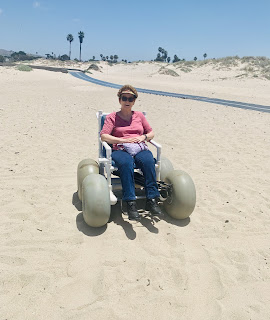


Notice the blue mat behind me


Before our trip back home, I needed to use an accessible restroom. My supersized wheelchair  would not fit in the door.

Fortunately, my husband was able to grab my lightweight portable walker stored beneath the wheelchair and I was able to use that to get into the bathroom. Beachgoers who only use wheelchairs would need to be pushed to their parking space, swap the beach wheelchair for their personal wheelchair, travel back to the restroom and use the facilities, then repeat the process in reverse to get back in the beach wheelchair. (Which begs the question: what do you do with the giant beach device while you are using your wheelchair? Leave it unattended in the parking lot?)

Once we knew the basics of how to reserve a beach wheelchair and where to go on SanBuenaventura Beach, we were prepared for a return trip with our out-of-town guests. Again there was no answer when I tried to call ahead. This time we knew where to go for help and parked near where the blue mat was. Getting my chair and getting to the sand via the mat, was easier.

But our guests arrived before we did and asked a lifeguard where the blue mat was. His response: “We don’t do that anymore.”

Here is what I learned from dipping my toe into the world of accessible beach wheelchairs.

Who knew there are many beach wheelchairs available to borrow?

Certainly not me. When I became disabled nearly 16 years ago, nobody gave me a guidebook about how to live my new mobility-impaired life. It would have been nice to read though and see a mention of the availability of beach wheelchairs, instead of finding it out now. My research on the San Buenaventura State Beach website led to other helpful places where I learned they are available to borrow at many, many beaches. The California Coastal Commission lists 90 beaches in 15 counties where you can reserve a chair — a few have electric as well as manual. Los Angeles County publishes a Beach Wheelchair Information Sheet that shows 28 chairs are available at 16 beaches. While many of the state beaches require a reservation, none of the ones in LA County do. You must show an ID to borrow one and comply with any time limits imposed by the beach. Many of the wheelchairs are checked out and returned to a lifeguard, which the guides say may not be available due to other duties.

Using a beach wheelchair is not for introverts


You will attract a lot of attention. The wheelchair makes a lot of noise while it traverses parking lots or walkways. The oversized chair makes an over-the-top statement for its user: Yes, I’m disabled and I’m willing to use this somewhat wacky contraption so I can get on the sand! I’ve used a beach wheelchair twice for a total of about three hours and I got many smiles and stares and several questions. My husband was amused when a man asked him if he built it for me. My favorites were three state beach employees who I encountered near the accessible restroom. They acted amused and asked, “Where did you get that?” Here, we replied. They had no idea such a thing was available. One of them asked to take a picture of me in the chair. I said yes.

You will need an able-bodied, patient helper to help you manage the chair


It’s not easy to push a large awkward beach wheelchair. Or to make turns. Or to calm a newbie who might be apprehensive about being tilted back to get over bumps in the path. And your helper will have to do the running around, finding the right person to talk to and guard the beach wheelchair while you are in the restroom. I was able to sit in the chair fairly easily, with my hubby folding up my portable walker and storing it. But I can imagine it would not be easy to transfer to beach wheelchair from a regular wheelchair — the huge plastic wheels would get in the way. My friend who uses a wheelchair said she sat in a chair like the one I used at her daughter’s beach wedding in Hawaii 10 years ago. She doesn’t remember having trouble getting in it but she says she was stronger back then. Cory Lee, an experienced disability travel expert, offers this video to explain how he is lifted into the beach chair from his wheelchair in Florida. Not many wheelchair users have the help or equipment to accomplish this.

Do your homework before heading to a beach that offers wheelchairs


Some of the beach websites I’ve found give details like how many chairs are available, where the disabled parking is and whether the beach has mats to help get to the sand. Others just give a number to call. I would recommend that you give it a try like I did before arranging a beach outing, particularly one that involves other people. Because we figured out some of the kinks, my second visit went much better than the first. I wouldn’t want a mobility-challenged person to show up for an important gathering, only to find the chair won’t fit into the restroom or to learn they were the last of the first-come first-served wheelchair borrowers. And remember, not too many people know about the existence of the beach chairs. The local Ventura newspaper ran an article in May about the installation of a new mat at Harbor Cove Beach to allow people using chairs. The local Ventura newspaper ran an article in May about the installation of a new mat at Harbor Cove Beach to allow people using wheelchairs or pushing strollers an easier path to the water. The story says the mat will be pulled up in late fall and rolled out again in the spring. It calls the mat “the only one of its kind at a Ventura beach”.

Ummm. That is not correct. The mat where I used my beach wheelchair was at a Ventura beach 3 miles away.

So if you use a beach wheelchair and a mat to ease your path to the sand, or you see someone who does, spread the word. Not enough disabled beach-lovers know about them. And while finding and reserving a chair is a not always a smooth process, think of the payoff: A day at the beach.


Worth all the effort

Friday, January 7, 2022

My Blog is 10 Years Old. What it’s Meant, How it’s Going and How I’m Doing

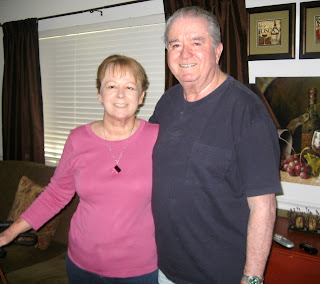
My brother recently sent me a picture of my dad and me, taken in 2011. I am wearing a necklace given by a friend as a semi-gag gift. It’s a little pink computer on a chain, in celebration of the publication of my blog.

I’m not good with dates, and I couldn’t tell you if asked when I started this blog, but I knew I only wore that necklace on one trip and the picture was taken in 2011.

And that is when I realized my blog is 10 years old.

Wow.


My dad Frank Diamond and me in 2011


When I was going through torturous years fighting my rare non-Hodgkins lymphoma, friends suggested I write about my experiences.  Good idea, I said. But first I have to be able to sit up at the computer without being in horrible pain. I deflected all suggestions about writing while lying in bed or using a dictation program to compose. My three decades in journalism taught me to create while I type sitting up and I simply couldn’t break the habit.

So I took an online class on how to start a blog. Ha! my-tech-friendly kids said. You do not have to take a class to publish a blog. Well, I did. 

Our instructor made us sign up for Facebook and Twitter,  which I had been reluctant to do. She helped us customize our websites and focus on our missions. We had several writing assignments a week and we improved though feedback. So when we were ready to publish, we had several posts ready to share.

After six years of living my new disabled life, I had plenty of material. I had spent nearly five months straight in a hospital bed, finished a 15-month regimen of intense chemotherapy (enough, my doctor said, to kill an elephant), faced temporary paralysis and the inability to speak. I had lived with excruciating pain due to multiple compression fractures and dealt with steroid-caused osteoporosis and cataracts. I was released from the hospital and began intense home physical therapy to regain my ability to walk. Then the cancer came back a year later. In this round, I faced a terrifying bone marrow transplant, total body irradiation and chemotherapy that was seven times stronger than what I endured before. 

I began another slow journey of recovery.

I had enough experiences and opinions to fill a book.

Instead, I wrote my blog. Fifty-six posts in the last decade: 23 the first year, 14 the next and two or three in the subsequent years. In 2019 and 2020, I only published one. Last year, although I had two topics in my head for months, I didn’t write one. I was spurred on to compose recently after realizing theviewfromthehandicappedspace had turned 10 years old.

My excuse for not publishing more? I’ve been living my life.

Going to an exercise class twice a week, reading books, going to movies, celebrating happy occasions, mourning bad news. Meeting up with friends and family. Hugging and virtual hugging a lot. Attending book club meetings, going out to breakfasts, lunches and dinners and occasionally brunches or happy hours. Going on vacations, attending plays and concerts. Taking every opportunity to toast at every occasion, sometimes multiple times at a sitting. I am mindful of celebrating that I am still here with others whom I love.

I’ve also been busy seeing endless doctors, dentists, oral surgeons, physical therapists, acupuncturists and specialists I had never heard of. Test after test and appointment after appointment. 

After a decade, I’ve reached a point in my life where I think I am physically as good as I’m going to get. There has been a change for the worse in my ability to walk and balance. The neuropathy in my legs has intensified and I am weaker and more imbalanced than I have been in years.

While doctors order tests to find out if there is a medical reason for this and I attend regular physical therapy appointments, I am getting by doing all the things I used to do, but with rides and assistance from dear family and friends.

But I still plan on sharing through my blog. I know it has helped a lot of people already. 

In 2011, I chose the title for my blog and I wrote its purpose: For people who find themselves in lives they hadn't anticipated: seriously ill, disabled or caring for someone who is. I wrote a paragraph about the blog and I wrote a backstory, giving a short summary of how cancer had upended (and almost ended) my life. I wrote about everything I experienced. I criticized the layout of disabled bathrooms, lamented the poor choices of walkers and raged at rude able-bodied folks who park illegally in disabled parking spaces or rush by me to occupy the only handicapped stall in a public restroom. I talked about staying in one of the worst nursing homes and putting up with nutty (and possibly dangerous) hospital roommates. I lashed out at a concert ticketing system that is not friendly to disabled people.

I also celebrated the good things I have found over the years: the kindness of strangers, the establishments that have gone out of their way to assure accessibility, the comfort provided by my stuffed bunny and the joy of graduating to a real bed after more than a d0zen years in a hospital bed in my family room. I basked in the support of my family and friends, particularly at an amazing surprise fifth stem cell  transplant birthday party.

My most popular post by far was the one about disabled parking. I heard from lots of people in many states and a few other countries struggling to understand the rules. Some wanted to fight a parking ticket when they forgot to put up the disabled placard in a car, some wanted to know if their placard would be recognized in other states or countries (generally, it is), others sought to understand the requirements where they lived. And some wanted to rant against the lowlifes who park in the disabled spots with fake or improperly used placards.

While I don’t preach about my experiences with cancer or my blog, I am quick to offer support when I hear of someone with a new diagnosis or preparing for a bone marrow transplant.  I’ll email my go-to blog posts: one about hearing the initial news and the other a summary of important things I learned. I offer any other help they need. 

Dreading chemotherapy-induced hair loss? I’ll send the post I wrote about the hairy truth.

Facing a bone marrow transplant? I’ll send my post about that and will counsel  you by phone, as some have requested.

Many people have expressed gratitude for this advice. And two bone marrow transplant recipients have personally thanked me (via phone calls) for helping them through the process. One person had his wife call me from his hospital bedside to ask the name of the drug I had recommended to ask for if the nausea got too bad. (It was intravenous Ativan.)

All is not easy in my life these days. I have a compromised immune system so keeping safe through COVID-19 is vital to me. Also, my recent spills have been particularly troubling. I had three serious falls within a five-month period in 2021. (I’ve had more than a dozen since getting sick, but these were extra concerning due to their frequency.) Two required visits to urgent care to make sure I hadn’t  damaged my bones or brain when I slammed my head against a door one time and the asphalt the last.  I did not, meaning my Prolia is helping with my osteoporosis and my head is pretty hard.

I believe I’ve accomplished what I intended when I first started the blog: to make folks more aware of what living in a disabled world is really like and providing a glimpse into the inequities I and others face on a regular basis. I am ever grateful that I survived and beyond touched by the support of my family and friends. I am thrilled when I hear from friends whose eyes have been opened to the needs of the disabled: someone who teaches her children it’s not OK to use the handicapped stall, another who tells me how I would love a particular place because it is very accessible, and one who visited a restaurant ahead of time before we went to lunch there to investigate the layout and the ladies room. Another friend, when deciding on an office for her psychology practice in an historic building, made sure there was an accessible room for disabled patients to use. She was asked did she have any disabled clients? No, she replied, but I might. And others who rented offices in the same building might. The same friend made her remodeled bathroom accessible for when I come to visit.  Still another added a grab bar in the shower for when I am a guest. Others bought a portable ramp I can use when stepping into their home.

After I found myself in tears hearing the Tom Petty song “I Won’t Back Down” the first time I slowly navigated a Relay for Life survivors’ lap, I adopted it as my theme song for life. “You can stand me up at the gates of hell”- I might be leaning against a wall and desperately clinging to my walker - “but I won’t back down.”

My New Year’s resolution? To keep living my life and writing a blog post or two.

Happy 2022.


Wednesday, May 4, 2016

On the Road: Misadventures in Disability


Around my hometown, I prefer to frequent handicapped-friendly establishments. Sure, they are all supposed to be ADA compliant, but some just don’t make sense or are extremely difficult to navigate. I know where it’s a pain to get a parking spot and where it’s tough to maneuver through the aisles or tables.

I’d rather go to a store or restaurant where I know it will be easy to get parking, where I can guide my walker easily while inside and where the bathrooms are accessible and easy to navigate.

But it’s a whole different story when I hit the road. 


Some recent trips to Phoenix, where I spent 20 years as an able-bodied resident, showed I am throwing caution to the wind when entering unfamiliar territory.

A few months ago, we went to Phoenix to attend a reunion of newspaper people I used to work with. It was at a Mexican cantina near the university in Tempe. I had been there before when I lived in Arizona, before cancer (lymphoma) left me disabled. I was looking forward to a festive get-together with former colleagues.

My heart dropped when the hostess pointed to a private room UPSTAIRS. I looked at several steep stairs -- the equivalent of climbing a mountain for me. Was there an elevator? we asked. No.

I almost cried. Almost. After driving nearly seven hours across the desert to see some people I hadn’t seen in decades, I didn’t want to greet them with puffy, red eyes. 

Was there an alternate route with a ramp? we asked.  No. Was there an easier way? Yes, I would have to go through one of the dining areas, squeeze through the kitchen and up the alternate entrance with only three steeper steps and no hand rails.  

Super.


I had to interrupt the kitchen staff and then find two people to help me up the stairs. (Fortunately, I had one -- my husband -- with me.)

Is there a restroom upstairs, I asked? No. There was only the one downstairs. 

Harrumph.

I thought I’d better use it before going upstairs. I would limit myself to one beverage   because I knew it would be a huge deal to get me down the stairs and back up. 

The ladies room had one disabled stall with a handwritten sign on it, saying “out of order.” I could not use any of the other non-accessible stalls.

I made my way back to the front of the restaurant and told the hostess that the disabled stall in the ladies room was out of order. Was there another bathroom in the place that I could use? 

Umm. She didn’t think so. She seemed thrown for a loop that I was even asking a question, any question. This one seemed to mystify her.  She asked another worker, who was equally perplexed. Then they brought out a manager, who told me there was no alternative restroom for ladies, but I could use the men’s room. 

Super.

He checked to see that that bathroom was empty, then waited outside while I used the handicapped stall. When I got out, I thanked the man for his help. He said to let him know if I needed to use the restroom again.

Yeah, right.

As the day progressed, the place would be more filled with beer-guzzling college guys who I’m sure would be thrilled to find their bathroom closed while I slowly used the only available handicapped stall in the joint. 

Upstairs, it was a wonderful reunion: filled with hugs and memories, pride in what we had accomplished and an undercurrent of sadness at how the newspaper business is in a painful decline. Of the roughly 100 people in attendance, several were older than me. Some had faced medical challenges, like I had. But no one else attending the event had limited mobility and faced the same roadblocks as I had.

Lucky them. If there had been anyone who used a wheelchair, they would not have been able to attend the party.

When the affair ended, two people helped me down the steps and my husband and I walked to my car. We decided to stop for dinner at a tiny, single-level restaurant near where we used to live.

Thankfully, the disabled parking spot was right in front and the restrooms were a few steps away from our seat. But when I finally got to use the single ladies room, I discovered it was not handicapped accessible. 

Really.

More recently, I attended a wedding in Phoenix. We stayed at a nice hotel in an accessible room. But the disabled parking spots were nowhere near my room. Of 40 spaces outside our building, not one was designated for a disabled person. And there were no curb cuts -- the slanted pavement where someone in a wheelchair or walker can transition from the lot to the sidewalk.

So even though there were plenty of empty spaces, if someone parked close to my room to let me in or out of a vehicle, I could not get up or down from the sidewalk. 

The nearest handicapped spots and curb cuts were at the end of my building, quite a journey for me as I pushed my walker under the Arizona sun. 

The wedding venue was a lovely outdoor restaurant/garden property that had two disabled parking spots close to where the event was taking place.

Yay.

Two large port-a-potties were available for guests to use. There were stairs leading to them, so they were inaccessible to me.  My friend (the mother of the groom) had checked out the venue in advance because I had previously told her about a lack of accessibility at another part of the facility.  A staff member showed her a single unisex permanent restroom that I could use. The staffer said it was accessible.

I found out the day of the wedding that it was not. 

It was a huge effort for me to get inside the small bathroom. I  knocked over decorations as I moved around the tiny room, squeezing the handles of my walker to make it narrower. (A mobility aid without this feature simply would not have fit in the room.) And the toilet was extra low to the ground with no grab bars to help someone like me get on or off the commode. I might still be stuck on the seat if I hadn’t planned ahead and brought a small portable toilet topper, discreetly carried in a fashionable zipped-up tote. But it was still a major effort to simply get up off the toilet with my weak legs.

Although the wedding and reception were absolutely lovely and lots of fun, I had to leave early because getting to and from the restroom (and on and off the toilet) was simply too difficult for me. I was worn out.

On one of our drives home, we stopped at a rest stop in California. The ladies’ room was temporarily closed for cleaning. We were directed to a back-up single room bathroom. It was available and handicapped accessible.

Yay. 

There were two large storage buckets in front of the sink and paper towel dispenser. 

Boo.

The door wouldn’t lock so my husband stood by, making sure no one entered while I was inside. While I maneuvered around the buckets to use the toilet, and contorted myself to wash my hands and dry them, a few ladies were gathering outside. I could hear them talking, anxious to use the only available public restroom.

Finally finished, I tried to open the door. It was stuck. Fortunately, my husband was right outside. I hollered at him through the door that I couldn’t get out. He tried to push while I pulled. It didn’t open.

I had a moment of panic and a brief vision of me stuck for hours in the hot bucket room with a mob of angry women outside, trying not to wet themselves.  

We pushed and pulled with more force and eventually got the door unstuck. If I had been in a wheelchair or on my own, I would not have been able to use the room.

Once freed, I made my way to our vehicle and we headed for home sweet home -- where I know the locations of the best accessible establishments. Yay.  


Thursday, March 27, 2014

What if the Driver Blocking your Disabled Parking Spot is a Member of Law Enforcement?


A regular topic of my blog posts is abuse or disregard of disabled parking spots. Some people just are uncaring and flagrant about breaking the law.

But what if the people blocking your spot are members of law enforcement? 

This happened to me recently when some LA County Sheriff’s Deputies blocked the only handicapped spot at my post office. It happened on the same day the local head of the district office was introduced in our local paper.

I sent him this letter in the mail the following day:

On Thursday, March 6, the same day the Signal ran an article about you becoming the top deputy in the Santa Clarita area, I was disappointed by actions of some deputies and annoyed enough to alert you to the incident.

I have lived in Castaic for the last 11 years and have been disabled for nearly nine of those years after a cancer battle. A former journalist, I write a blog about what I’ve learned and what I think needs to be brought to the public’s attention as I go through life on this different path. My blog is called View from the Handicapped Space.

A common topic is disabled parking and how frustrating it is to see so many insensitive people making my life worse by disregarding the law, either due to insensitivity or ignorance.

I’ve enclosed two of my posts regarding this issue, one which highlights the problems with only one disabled spot at the Castaic Post Office on Franklin Parkway and the other which points out how often careless motorists block such spaces.

Imagine my chagrin yesterday afternoon when I arrived at the post office around 2 p.m. to find the insensitive people blocking the only handicapped space there were three sheriff’s deputies.

Their vehicle was parked perpendicular at the end of the only disabled spot. There were plenty of other empty spaces around. I could have parked in one of those a distance away, but if you look at my post that is titled “Grrrr” it’s really a chore for me to walk all the way around to the slanted sidewalk so I can go up the handicapped ramp.

They did not appear to be responding to an urgent matter. The lights on the car were not on and they were walking slowly on the sidewalk, meeting up with a woman who they then accompanied into the office. At that time, I rolled down my passenger window and hollered at them to get their attention, waving my disabled placard. A female deputy approached and I asked her to please move the car, explaining it was blocking the only spot.

She did, without apology.

When I got into the post office, the deputies were in the area of the postal boxes, discussing something with the woman.

I would hope you would take a note of this incident. And emphasize to all your deputies that blocking a handicapped spot -- even for just a short time -- is rude and insensitive to citizens who they are supposed to be working to protect. 

I did not get a response.

In the big law enforcement scheme of things, disabled parking problems probably rate near the bottom. But from the perspective of all those who rely on those spaces to get to where they want to be, this is a huge deal. How many of us will have brushes with crime in their everyday life? For me, I have a few times been the victim of a thief. And, thankfully, I have never been the victim of a more serious crime.

But I routinely deal with disabled parking lawbreakers: people who are not handicapped but use the spots anyway, drivers who have borrowed disabled parking placards and think it’s OK to take the spaces from the disabled, drivers and passengers who literally jump out of the cars to go to a restaurant or shop. I feel powerless to do anything about them, except give them dirty looks.

My former hometown of Phoenix has a hotline for reporting illegal disabled parkers. No such thing exists in Southern California. One guy, an advocate for wheelchair users, recently made the news in Phoenix when he spotted and photographed an able-bodied Glendale Police officer in a disabled spot and requested that the officer be ticketed.

In that case, the Glendale Police Department chief and others responded right away, apologizing in an email. A police spokesman said such behavior is unacceptable and said the department was handling the incident internally.

Three weeks after I sent my letter, the sheriff’s office has not replied to me.

The disabled man in Arizona suggested that if the officer in question was not ticketed, the department should make him undergo disability sensitivity training.

"It's an issue everywhere," Timm Aguirre said. "This officer's actions show that he's saying maybe it's OK to just park somewhere just for a little while. It's just one spot.
But it's not OK."

Couldn't have said it better myself.


Monday, August 5, 2013

Yippee (Continued)! More Thumbs Up to a Few Places that Accommodate the Disabled


Enough griping. Time for three more thumbs up to places that have made my disabled life a bit easier recently.
Any business that has built-in entry mats

This a catch-all. I’m sure there are plenty. Two buildings I frequent locally --  one dental, one medical -- were built a few years ago by an incredibly considerate company.

The mats at all the entrances are built into the flooring, not just placed on top of it. It is a subtle, attractive way to accommodate the disabled. I don’t know if that’s why they did it, but I like to think it is.  

I say a silent hallelujah every time I enter one of those buildings. It might not seem like much to able-bodied people, but it makes me happy every time I travel over them. The alternatives, which are way more plentiful, are rugs that I am always curling up and getting my walker glides stuck under.

When these rugs or mats are outside and inside an entry, it takes quite an effort to pick up my walker to get over the first one without screwing it up, then navigate the metal threshold barrier (which sometimes traps my walker glides and rips them off), then the mat inside the door.
Built-in rug

My fitness center has three of these annoying rugs before I can check in at the front desk. My post office has two of them. Because I can’t bend down to fix them, I am often leaving disheveled rugs in my wake. Probably a safety hazard.


Goldstar, the online entertainment discount company

A friend of mine, knowing how I enjoy  live theater and concerts (and also knowing I love a discount), suggested I check out the offerings on Goldstar.

It’s a national company that says it wants to encourage more people to take advantage of entertainment offerings by working with providers to make tickets more affordable.

Then I remembered I am disabled. (Believe it or not, I forget sometimes. Like the time I bought a two-pack of umbrellas from Costco only to realize once I got home there is no way I could hold an umbrella.) And I’ve had such problems finding accommodating venues that I gave up before I explored Goldstar any further. Sure, the tickets might be cheap but would I be able to attend with my walker or wheelchair? Or would the seats be in the inaccessible rafters?

Not worth the trouble or the gamble, I thought.

But then my daughter ordered half-price play tickets for the both of us, using Goldstar’s instructions to email them right away to specify any special needs requests.  Goldstar said they would get in touch with the venue to seek accommodations.

On their website explaining this policy, Goldstar goes on to say, “Not all venues offer special-needs seating, but we're typically able to work it out, and we'll certainly do our best to make it happen.”

And they did. 

Which leads me to thumbs up for the venue.

 La Mirada Theatre for the Performing Arts

This beautiful theater in La Mirada, California is extremely accommodating for the disabled, from parking to seats to restrooms.

Disabled parking is plentiful, close and free. The entryway to the theater is very accessible and flat. I note both of these accommodations because I've been to many a restaurant or theater where it is quite a hike from the parking spot to the entrance or an uphill climb to even get in the door. It was a relief to be able to park close by and walk in easily.

Inside I found couches in the lobby and comfy seating in the lounge area where you can wait before the curtains go up. Again, I've been in places with only uncomfortable metal or plastic seating while you are awaiting entrance to the theater. The La Mirada Theatre even had a lit fireplace, adding to the homey feel. Beverages come with lids on them so you can take them safely into the theater.  


My daughter had requested aisle seats for me in my walker and her. She wrote that I couldn't go down stairs. After getting our tickets at will-call, we sat at  perfect floor-level seats at the end of a long aisle. 

At intermission, when people were swarming to the restroom, an attendant inside directed a steady line of women to available stalls. And she saved the disabled stall only for handicapped people. Yay.

It made the experience fast and easy for everyone.  And the play was fantastic.