Showing posts with label non-Hodgkin’s lymphoma. Show all posts

Wednesday, February 8, 2023

An unexpected holiday surprise - yet another fall

 ‘Twas the day before Christmas 2022 and all through the house, not a creature was stirring, not even a mouse.


But at 3 a.m. there arose such a clatter. Four strong creatures arrived - paramedics - to see what was the matter.


I had fallen getting out of bed to use the restroom, slamming my hip against my nightstand, knocking my shoes off, overturning my walker and splaying my legs beneath me. My husband, daughter and I spent an hour trying to get me up, then we decided to call for help. It took just a few seconds for three paramedics to get me upright and put me on the bed. 


The “I’ve fallen and I can’t get up” refrain from the old TV commercial has been an unspoken tagline of mine since I became disabled. While it was the subject of parodies and jokes back in the day, I no longer find the phrase amusing.


My disability knows no season or place. I can fall in the kitchen or on the street or in my bedroom no matter what the date or circumstances. I’ve taken at 16 spills since my non-Hodgkin’s lymphoma diagnosis nearly 18 years ago. They have resulted in trips to the ER, visits to urgent care, CT-scans and X-rays and several follow-up doctors’ appointments. Fortunately, since I finished my chemotherapy treatment and bone marrow transplant nearly 15 years ago, I’ve had no broken bones. Although I’ve had plenty of aches and pains and nasty bruises. The Christmas Eve tumble produced a bruise about the size and shape of Delaware, 


From the outside, I appear to be doing well after a near-miraculous recovery from cancer and a bone marrow transplant and for that I am forever grateful. But the truth is I struggle daily just to stay upright. I can lose my balance just standing around or when I go to take a step. I have neuropathy  (tingling, numbness and pain) in both lower legs and it has gotten worse the past few years. Also the strength in said legs has been diminishing. I have given up driving, I often need help getting up from a chair, and steps I could manage before are too high for me to ascend unassisted.


It’s not like I haven’t done my best to improve or maintain my strength, stamina and balance. Over the last decade-and-a-half I have sought help through medicine, regular exercise, aqua-therapy, acupuncture and multiple rounds of gait-and-balance physical therapy. 


I can imagine the shape I’d be in if I didn’t work so hard to improve my muscles and balance. My latest physical therapy sessions were ordered in 2021 after I had taken three falls in five months. 


The first spill was in at a darkened hotel room in Tucson, where I missed sitting on the bed and instead fell to the ground, managing to slam my head against the door and collapsed on a metal part of my tri-wheeled walker, gouging a bloody chunk out of my lower leg. 


The second was at a truck stop bathroom along Interstate 5 in central California as I was turning from the sink to the paper towel dispenser. It was a nice, clean restroom (a good place to fall, as public bathrooms go). A woman asked if I needed help and she corralled a man from the hallway to assist her in raising me up. I cut my elbow but didn’t hit my head.


The third was a doozy. I was standing on the asphalt at the LA Farmers Market, waiting while my husband bought something a short distance away. I had locked the brakes on what I called my all-terrain walker and shifted my stance to get more stable. It had the opposite effect and I dropped backward, falling like a tree, hitting my head hard on the pavement. I declined an offer of an ambulance and went directly to urgent care, where I learned I hadn’t caused any major injuries.


And so I went to six months of twice-a-week physical therapy sessions, trying to build my muscles and improve my balance. On the last day, the therapist assessed my progress, measuring my strength, timing my walk and making calculations. 


I asked what the results showed. 


“Well, you didn’t get any worse,” she said. 


Quite the endorsement for all that effort. 


A few days before my Christmas Eve fall, I had mentioned proudly to a friend that it had been eight or nine months since I had taken a tumble. I joked about putting up a sign like those in businesses that say “X number of days without an accident.” Way to jinx myself, some would say.


Ever the optimist, I seek the silver lining in each of these cloudy stumbles. I try to look at each fall as a learning opportunity, something I won’t do again. I have realized my disabled self cannot just walk like a normal person. My legs and feet don’t work like they should.


Lesson 1.  Concentrate on deliberately walking (heel, pad, toe) and lifting your feet. Any distraction, such as pointing out a lovely flower or bird while outside can make me lose my balance. That happened on a Santa Barbara sidewalk when I crashed to the ground a couple of years ago. My husband and a young man who happened to be walking in the crosswalk toward us helped me up. 


Lesson 2. Put your brakes on if your walker has them or have someone hold on to your walker as you navigate a step or slanted terrain. My worse fall occurred in 2012 when I was headed out my front door with a friend to go to lunch. I lifted my tri-wheeled walker over the threshold and it rolled out ahead of me. I slammed my face into the concrete, breaking my glasses, cutting my face and leaving a large lump and horrible bruises.

Shortly after my porch fall

A few days later 


Lesson 3:  Keep your phone with you at all times. I figured this out when I fell in our small half bath turning from the sink to the towel rack. Fortunately I had put the house phone in my walker pouch because my sons were due from an out-of-town trip that night and carried it in case they called. The towel rack and I crashed to the ground. I maneuvered around a tight space to reach my phone, and summoned my husband to help me up. I later learned to pack my walker with more in case I fall again.


Lesson 4: Injuries may not be immediately apparent, so be vigilant. What I’ve come to call the Spanx Incident occurred during my first (and last) attempt to put on Spanx shapewear. With the torturously-tight stockings almost on, I walked gingerly to my dresser to fetch another article of clothing. I tumbled, brought down a computer desk and a stereo system. After a friend helped me up and gathered the debris, I didn’t see or feel any physical damage and finished getting ready. Off we went to a festive book club holiday luncheon. That night when I took off my shoes, I discovered a very bloody and very swollen left big toe. When I went to the doctor the next day to see if it was broken, he said it was not, just smashed. And he told me, “The good news is you can’t feel your toe. The bad news is you can’t feel your toe.” A year after that spill, I managed to break another fall in the kitchen with my right hand. I did a jungle crawl to reach my phone and called my husband for assistance. I had no visible injuries so we proceeded with our neighbors to what I thought was a dinner for the four of us. It turned out to be a surprise party planned by my husband to celebrate my fifth birthday, post stem-cell transplant. I spent much of the rest of the day in tears and in a kind of shock, seeing a room full of family and friends who had traveled from all over to celebrate with me. It wasn’t until the next day that I woke up to find my right hand swollen to baseball glove size and unusable.

Hugging a friend at my surprise party 
oblivious that I had injured my right
hand 


Lesson 5: A smart watch is a necessity. It provides a nice alternative to the device the “I’ve fallen and I can’t get up” commercial was trying to sell. I can send messages or make calls on my Apple Watch just using my voice. And because it is waterproof, I can (and must) wear it in the shower. I learned that rule after a ceiling-to-floor caddy collapsed on me mid-shower, opening the door, spraying water all over the bathroom. I was trapped on my shower bench, unable to reach the faucet. Fortunately, my husband was home and I was able to holler loud enough for help. Now, I don’t take a shower unless someone is home with me and I am wearing my charged Apple Watch. 


Lesson 6: Always wear non-slip socks to bed in case you have to get up in the middle of the night to use the bathroom. Add a grabber by your bedside so you can move too-far shoes closer. On Christmas Eve at 2 a.m., I sat up in bed and tried to slip into my shoes.  It wasn’t dark. I made sure I had a nightlight on, particularly after the Tucson fall. But one shoe moved further away the more I tried to get it on. When I stood up to try to reach it, my sock slipped on the bedside rubber mat (which I use to help me get in my bed and to prevent slipping on the floors). I crashed hard against the nightstand. My body was in such a position that my two helpers couldn’t raise me up and we couldn’t get a foot underneath me on the mat to help me stand. What I needed was a couple more strong people. (My husband had recently hurt his back so I didn’t want to make it worse by wrenching me up.) We could have called friends or neighbors but I didn’t want to wake them up at 2 a.m. Christmas Eve. Thus, the 911 call. 


I didn’t break anything, as a later visit to urgent care proved. I have had osteoporosis since I was 49 - caused by massive amounts of prednisone beginning early in my treatment - and my oncologist says I could easily break a hip with a minor fall. Multiple falls later, I have not broken a bone. Perpetual knocks on wood. And some credit should go to Prolia, the high-dollar bone-buildingmedicine injected into my arm every six months. The drug is currently causing me other problems, but that’s a topic for another day.


Back on Christmas Eve, when the firemen had taken my vitals, filled out the paperwork, and finished their job, we thanked them profusely.


“Merry Christmas,” one of them said, cheerfully.


And to all a good night, I thought. I am hoping for a more stable new year. It’s been 44 days without a fall. 


Wednesday, September 14, 2022

Beach wheelchairs are everywhere. Who knew?


I went to the beach this summer. I relaxed in the sand, just feet away from the water, watching children and adults and dogs having a wonderful time walking, playing, digging, relaxing, wading and swimming.

Occasionally, I would close my eyes, take a deep breath and drink in the soothing sounds of the waves.

That might not seem like a big deal to many, but it was to me. I’ve lived in Southern California for nearly 20 years and I hadn’t been that close to the surf since 2014.


Because I am disabled and have depended on a walker since 2005, sand is not my friend. “A day at the beach” does not connote ease or relaxation. For me, that phrase signifies frustration and a bit of mourning for what I am no longer able to do.

But this summer, I discovered beach wheelchairs.

Hallelujah!

With an asterisk.

Yay to their availability and affordability.

Boo to the fact that their existence is news to many, including the people who can use them and some staff at the beaches. And another boo to the cumbersome borrowing process and difficulty of getting into an accessible restroom from the monster truck version of a wheelchair.

A California girl, I cherished the proximity of the ocean and have many fond memories of days at the beach in northern, central and southern parts of the coast.

When I became disabled after my horrifying battle with cancer, I realized my limitations and resigned myself to enjoying the view from a car or sitting on a bench near the sand.

I learned on Facebook about Sabrina Cohen, a woman in Miami Beach who was working to make beaches accessible for the mobility-impaired. I commented, “We could use you in California.”

In 2014, I had my last close-to-the-surf excursion. I was determined to explore the possibilities of using my walker at the beach. My husband, who has helped steer me through non-Hodgkins lymphoma, a stem cell transplant and disability, packed in the car two of my walkers, foldable beach chairs and a blanket. When we got to Zuma Beach in Malibu, he guided me as I trekked unsteadily through the sand, lifting my walker step-by-step. I worried sand would somehow ruin my mobility aid. When I got to a midpoint in the sand, I transferred to a beach chair for a few minutes and then lay down flat on the blanket blissfully.


I don’t remember how I got up, but my husband must have put forth a Herculean effort. In the ensuing years, my muscles have weakened so that I often need assistance just getting up from a regular chair (from two people if possible). So I’ve scratched lying in the sand from my to-do list.

I did make a mental note when I saw an article somewhere that said a beach in Ventura had accessible wheelchairs available. I never investigated it further until this summer after learning relatives and their grandchildren were planning as visit and they wanted to go to a beach. A quick computer search led me to the San Buenaventura State Beach website which explained how to reserve a wheelchair free of charge over the phone.

We planned a trial run on a weekday when crowds would be minimal. The day before our excursion, I called the number listed on the site and left a message. When no one called back, I phoned  later in the day. This time a lifeguard answered, said he couldn’t reserve one for me and I should call back the following morning. I called again the next day and again no one answered. I left a message saying we were on our way there (a 40 minute drive) and hopefully we would be able to borrow the chair.

We arrived there without knowing who to contact. While I waited in the car, my husband walked to a few administrative buildings before finding someone to help us. After a few more missteps, we got a larger-than-life beach wheelchair, which was one of four in a storage container, under lock and key.

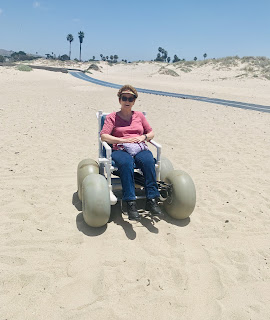
I was able to sit in it fairly easily and my husband placed my portable fold-up walker on the rack below. Then he had to push me through the parking lot and paved trails to the boardwalk where we reached the sand - and about a 10-inch drop off. I was nervous about being tilted back in the chair and wary about going off the edge. My husband began kicking sand toward the edge of the threshold, trying to level the terrain. A woman out for a walk asked if she could help. No thanks, we said.

She continued her walk then came back to tell us there was a blue mat a bit further down the beach to facilitate the transition from wood to sand.

And voilĂ , there was. (It would have been nice if the lifeguards mentioned that when we checked out the chair.)

My husband pushed me down the trail to where the mat was and maneuvered me in the sand toward the shore. We took in the view and the sounds of the waves and had a relaxing, miniature hand-held picnic, my husband sitting on one of the enormous plastic wheels.


Notice the blue mat behind me


Before our trip back home, I needed to use an accessible restroom. My supersized wheelchair  would not fit in the door.

Fortunately, my husband was able to grab my lightweight portable walker stored beneath the wheelchair and I was able to use that to get into the bathroom. Beachgoers who only use wheelchairs would need to be pushed to their parking space, swap the beach wheelchair for their personal wheelchair, travel back to the restroom and use the facilities, then repeat the process in reverse to get back in the beach wheelchair. (Which begs the question: what do you do with the giant beach device while you are using your wheelchair? Leave it unattended in the parking lot?)

Once we knew the basics of how to reserve a beach wheelchair and where to go on SanBuenaventura Beach, we were prepared for a return trip with our out-of-town guests. Again there was no answer when I tried to call ahead. This time we knew where to go for help and parked near where the blue mat was. Getting my chair and getting to the sand via the mat, was easier.

But our guests arrived before we did and asked a lifeguard where the blue mat was. His response: “We don’t do that anymore.”

Here is what I learned from dipping my toe into the world of accessible beach wheelchairs.

Who knew there are many beach wheelchairs available to borrow?

Certainly not me. When I became disabled nearly 16 years ago, nobody gave me a guidebook about how to live my new mobility-impaired life. It would have been nice to read though and see a mention of the availability of beach wheelchairs, instead of finding it out now. My research on the San Buenaventura State Beach website led to other helpful places where I learned they are available to borrow at many, many beaches. The California Coastal Commission lists 90 beaches in 15 counties where you can reserve a chair — a few have electric as well as manual. Los Angeles County publishes a Beach Wheelchair Information Sheet that shows 28 chairs are available at 16 beaches. While many of the state beaches require a reservation, none of the ones in LA County do. You must show an ID to borrow one and comply with any time limits imposed by the beach. Many of the wheelchairs are checked out and returned to a lifeguard, which the guides say may not be available due to other duties.

Using a beach wheelchair is not for introverts


You will attract a lot of attention. The wheelchair makes a lot of noise while it traverses parking lots or walkways. The oversized chair makes an over-the-top statement for its user: Yes, I’m disabled and I’m willing to use this somewhat wacky contraption so I can get on the sand! I’ve used a beach wheelchair twice for a total of about three hours and I got many smiles and stares and several questions. My husband was amused when a man asked him if he built it for me. My favorites were three state beach employees who I encountered near the accessible restroom. They acted amused and asked, “Where did you get that?” Here, we replied. They had no idea such a thing was available. One of them asked to take a picture of me in the chair. I said yes.

You will need an able-bodied, patient helper to help you manage the chair


It’s not easy to push a large awkward beach wheelchair. Or to make turns. Or to calm a newbie who might be apprehensive about being tilted back to get over bumps in the path. And your helper will have to do the running around, finding the right person to talk to and guard the beach wheelchair while you are in the restroom. I was able to sit in the chair fairly easily, with my hubby folding up my portable walker and storing it. But I can imagine it would not be easy to transfer to beach wheelchair from a regular wheelchair — the huge plastic wheels would get in the way. My friend who uses a wheelchair said she sat in a chair like the one I used at her daughter’s beach wedding in Hawaii 10 years ago. She doesn’t remember having trouble getting in it but she says she was stronger back then. Cory Lee, an experienced disability travel expert, offers this video to explain how he is lifted into the beach chair from his wheelchair in Florida. Not many wheelchair users have the help or equipment to accomplish this.

Do your homework before heading to a beach that offers wheelchairs


Some of the beach websites I’ve found give details like how many chairs are available, where the disabled parking is and whether the beach has mats to help get to the sand. Others just give a number to call. I would recommend that you give it a try like I did before arranging a beach outing, particularly one that involves other people. Because we figured out some of the kinks, my second visit went much better than the first. I wouldn’t want a mobility-challenged person to show up for an important gathering, only to find the chair won’t fit into the restroom or to learn they were the last of the first-come first-served wheelchair borrowers. And remember, not too many people know about the existence of the beach chairs. The local Ventura newspaper ran an article in May about the installation of a new mat at Harbor Cove Beach to allow people using chairs. The local Ventura newspaper ran an article in May about the installation of a new mat at Harbor Cove Beach to allow people using wheelchairs or pushing strollers an easier path to the water. The story says the mat will be pulled up in late fall and rolled out again in the spring. It calls the mat “the only one of its kind at a Ventura beach”.

Ummm. That is not correct. The mat where I used my beach wheelchair was at a Ventura beach 3 miles away.

So if you use a beach wheelchair and a mat to ease your path to the sand, or you see someone who does, spread the word. Not enough disabled beach-lovers know about them. And while finding and reserving a chair is a not always a smooth process, think of the payoff: A day at the beach.


Worth all the effort